what doea it mean all roads lead to the gypsy king


The Peutinger Table. Reproduction past Conradi Millieri – Ulrich Harsch Bibliotheca Augustana. Wikimedia Eatables
Today the phrase 'all roads leads to Rome' means that at that place's more than one style to attain the aforementioned goal. But in Aboriginal Rome, all roads really did lead to the eternal city, which was at the centre of a vast road network.

By Dr. Caillan Davenport (left) and Dr. Shushma Malik (right) / 01.19.2017
Caillan: Senior Lecturer in Classics and Aboriginal History and ARC DECRA Senior Research Fellow, The University of Queensland
Malik: Lecturer in Classics and Ancient History, The Academy of Queensland
We all know the phrase "all roads lead to Rome". Today, it is used proverbially and has come to mean something similar "there is more one fashion to achieve the same goal". Only didall roads always actually lead to the eternal metropolis?
The power of pavement
There was a close connection between roads and royal power. In 27 B.C, the emperor Augustus supervised the restoration of the via Flaminia, the major route leading northwards from Rome to the Adriatic coast and the port of Rimini. The restoration of Italia'south roads was a key office of Augustus' renovation program after civil wars had ravaged the peninsula for decades. An curvation erected on the via Flaminia tells united states that it and the most other commonly used roads in Italy were restored "at his own expense".
And road paving was expensive indeed – it had not been mutual under the Commonwealth, except in stretches shut to towns. Augustus and his successors lavished attention on the route network as roads meant trade, and trade meant money.
In 20 B.C., the senate gave Augustus the special position of road curator in Italy, and he erected the milliarium aureum, or "gilded milestone", in the city of Rome. Located at the foot of the Temple of Saturn in the Roman Forum, it was covered with gilded statuary.
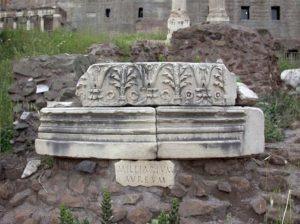
The Golden Milestone. Wikimedia Commons
According to the ancient biographer Plutarch, this milestone was where "all the roads that intersect Italy terminate". No one quite knows what was written on it, merely it probably had the names of the major roads restored post-obit Augustus's instructions.
The centre of the world
Augustus was bang-up to foster the notion that Rome was non merely the centre of Italy, but of the unabridged earth. As the Augustan poet Ovid wrote in his Fasti (a poem about the Roman agenda):
At that place is a stock-still limit to the territory of other peoples, merely the territory of the city of Rome and the world are ane and the aforementioned.
Augustus' right-hand man, Agrippa, displayed a map of the world in his portico at Rome which contained lists of distances and measurements of regions, probably compiled from Roman roads.
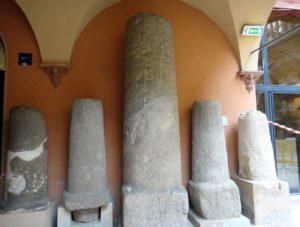
Roman Milestones in the Bologna Archaeological Museum. C Davenport
The Roman road network bound the empire together. Senators had begun to erect milestones listing distances in the mid-3rd century B.C., simply from the showtime century A.D., emperors took the credit for all road building, even if it had been done by their governors.
More than 7000 milestones survive today. In central Italy, the milestones usually gave distances to Rome itself, but in the north and southward, other cities served equally the node in their regions.
Augustus also established the cursus publicus, a organisation of inns and style-stations along the major roads providing lodging and fresh horses for people on imperial business. This system was only open up to those with a special permit. Fifty-fifty dignitaries were not allowed to abuse the system, with emperors cracking downwardly on those who exceeded their travel allowances (Bronwyn Bishop would non take fared well in the Roman empire).
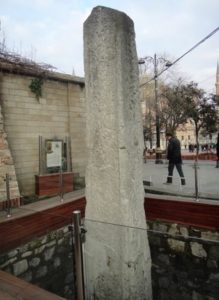
The surviving part of the Milion in Constantinople. C. Davenport
The clan between empire and roads meant that when Constantine founded his ain "new Rome" at Constantinople in the quaternary century A.D., he built an arch called the Milion at its heart, to serve as the equivalent of the Gold Milestone.
Many Roman itineraries accept survived because they were copied in the medieval menstruum. These tape distances between cities and regions forth the Roman route network. The "Antonine Itinerary", compiled in the third century A.D., even helpfully includes shortcuts for travellers. These types of documents were uniquely Roman – their Greek predecessors had not compiled such itineraries, preferring to publish written accounts of sea voyages.
The Roman road network had prompted the development of new geographical conceptions of power. This is nowhere more prevalent than on the Peutinger Table, a medieval representation of a late Roman map. It positions Rome at the very centre of the known earth.
Proverbial roads
Since antiquity, the phrase "all roads lead to Rome" has taken on a proverbial meaning. The Book of Parables compiled by Alain de Lille, a French theologian, in the 12th century is an early on example. De Lille writes that there are many ways to achieve the Lord for those who truly wish information technology:
A thousand roads pb men throughout the ages to Rome,
Those who wish to seek the Lord with all their centre.
The English poet Geoffrey Chaucer used the phrase in a similar mode in the 14th century in his Treatise on the Astrolabe (an musical instrument used to measure out inclined position):
right as various pathes leden diverse folk the righte manner to Rome.
The "conclusiouns" (facts) Chaucer translates into English for his son in the treatise come from Greek, Arabic, Hebrew, and Latin – and all came to the same conclusions on the astrolabe, says Chaucer, much every bit all roads atomic number 82 to Rome.
In both these examples, while the ancient idea of Rome as a focal betoken is invoked, the physical city itself is written out of the meaning. Neither de Lille nor Chaucer are actually talking virtually Rome – our modern "at that place's more than than ane fashion to pare a cat" would work just also.
A return to Rome
When the proverb started to get popular in 19th-century newspapers and magazines, however, the spectre of the urban center returned. Rome as the Eternal City struck a chord with this audience, which was reading and hearing about the exciting excavations taking place in Italy and Europe. Accordingly, the phrase took back a semblance of its original sense – Rome as the regal urban center – while retaining its proverbial import.

The idea of Rome as The Eternal City has long struck a chord. Tony Gentile/AAP
For instance, in July 1871, the Daily News'due south Special Contributor for the Times in India watched Victor Emmanuel Ii enter Rome in triumph equally the Male monarch of (United) Italy:
"All roads," says the old proverb, "atomic number 82 to Rome," and the proverb rose up with a foreign forcefulness to my mind to-24-hour interval … By what various paths has he at length reached the Quirinal [Hill].
Only as the King took diverse roads into the city, so his route to monarchy had been arduous and chequered. The Special Correspondent, on seeing the entrance of Emmanuel II, uses Rome as both an imperial metropolis and an end point for achievement – the King both literally enters the city and takes a number of "roads" to achieve monarchical power. The double use of the maxim is perfect and irresistible.
For other commentators, Rome remained the spiritual centre of the western world. Katherine Walker, writing for Harper'due south Magazine in 1865, described her journey from Livorno to Rome with a German Roman Catholic priest.
"We are inclined to think of the old saying true that 'All roads atomic number 82 to Rome'," she wrote. While the priest delighted in the urban center every bit the home of Pope Pius IX, Walker herself objected that her priestly guide could simply see the Pantheon as the church building Santa Maria advertizement Martyres, and non equally Agrippa's temple to the infidel gods.
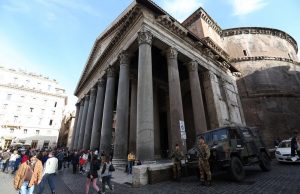
The Pantheon was Agrippa'due south temple to the pagan gods. Stefano Rellandini/AAP
While both aboriginal and mod Italian roads all pb to Rome, to Walker the city itself had drastically mutated from the dwelling of Augustus and Agrippa to that of Catholicism and the Pope. She finds this disappointing.
The idea of Rome
The expression "all roads pb to Rome" is a right reflection of both the sophisticated Roman road network and its visualisation in Roman monuments and documents.
Later, withal, the manner in which Romans boasted of the centrality of their metropolis transformed into a proverb that had zilch necessarily to do with real roads or, for a time, the real Rome. In the 19th century, travellers revived the phrase as a way of melding the ancient past with their modern viewing experiences.
Why is this conception of Roman power accurate, when compared with other myths in this series? We assume that Romans were gluttonous or their emperors were crazy because such myths feed into our prejudices, which are then reinforced by popular culture.
Roads are a much more mundane aspect of Roman life compared to Nero'due south declared excesses, which makes them a less obvious way to think about imperial power. But when nosotros hear the phrase "all roads atomic number 82 to Rome", we do not remember of paving stones, simply of the larger Roman roadnetwork – with Rome, its characters, and its history at the centre.
Originally published by The Conversation under a Creative Eatables Attribution/No derivatives license.
Comments
Source: https://brewminate.com/did-all-roads-actually-lead-to-rome/

Enregistrer un commentaire for "what doea it mean all roads lead to the gypsy king"